How to Choose Between Cork and EVA Recovery Slippers: A Comparison Guide for B2B Buyers
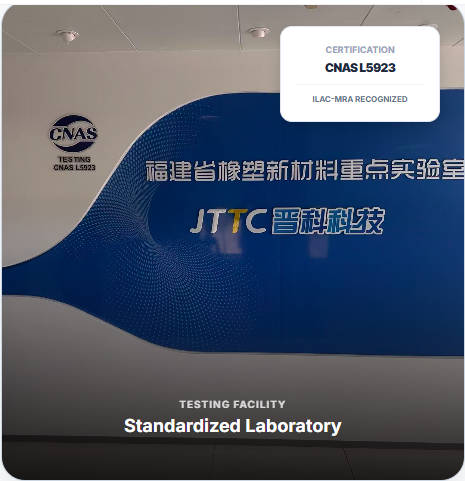
Cover: the manufacturer laboratory where recovery slipper materials, footbeds and components are developed and tested.
How to Choose Between Cork and EVA Recovery Slippers: A Comparison Guide for B2B Buyers
Choosing between cork and EVA recovery slippers is not a question of which material is better in the abstract. It is a question of which construction system fits your sales channel, your end user and the documentation you can maintain after delivery. ORTHOCARE, the recovery footwear brand of XIAMEN JERRYFOOTPRINT IMP & EXP CO., LTD, manufactures both systems: the Latex Cork Slipper line (models CS01 and CS02) and the EVA recovery slipper line (models L25, C22, A08 and D01). This guide compares those two lines at model level — material, construction, documented specifications, size curves and procurement terms — so the decision can be defended to a purchasing committee rather than made on a single sample pair.
Short answer: choose the latex cork line (CS01, CS02) when your program depends on a natural cork footbed story, a breathable and eco-conscious material position and a multi-layer footbed assembly. Choose the EVA line (L25, C22, A08, D01) when you need a single-material construction, a documented softness rating of 38–50 degrees and a published size curve for every model. Most distributors end up carrying both.
Why the Cork-vs-EVA Decision Breaks Down in Practice
Buyers rarely compare cork and EVA in isolation. They compare them inside a channel that already has a price architecture, a size curve, a compliance file and a customer promise. The decision usually fails in one of three predictable ways. The first is sampling by feel: a buyer receives one cork pair and one EVA pair, judges comfort by hand, and assumes the rest of the range behaves the same way. The second is assuming shared manufacturing logic — that both materials run on identical tooling, MOQ structure and documentation. The third is treating recovery slippers as a single category, when the two lines are built from different construction systems.
At component level the difference is concrete. The Latex Cork Slipper models CS01 and CS02 are built on a latex cork midsole with SBR and suede backing, which makes them a multi-layer footbed assembly. The EVA recovery models L25, C22, A08 and D01 are single-material EVA items with a documented softness rating of 38–50 degrees. Layer count changes tooling requirements, changes how many components your specification sheet has to describe, and changes how a size curve can be documented for retail and after-sales.
What the Recovery Footwear Market Says About Material Positioning
Market data supports treating recovery footwear as a mainstream category rather than a niche. Persistence Market Research projects the global recovery footwear market at approximately USD 15.3 billion in 2025, expanding to USD 24.6 billion by 2032. North America held the largest regional share at approximately 40% in 2025, according to Precedence Research.
Application mix matters more than headline size for a buyer choosing between cork and EVA. Precedence Research reports that the After Foot Surgery application segment contributed the highest market share in 2025, which places medical and recovery positioning — not general casual wear — at the centre of demand. Grand View Research values the global diabetic footwear market at USD 8.96 billion in 2024, with a projected CAGR of 7.7% through 2030.
Regulatory context is equally practical. In the United States, slip resistance for medical footwear is governed by ASTM F3445-21, published by ASTM International. Buyers distributing into clinical or healthcare channels usually meet this standard as a specification requirement rather than a preference.
One caution on market numbers: estimates diverge because the boundary between recovery and medical footwear is drawn differently by each research house. Dataintelo places the 2025 recovery footwear market at USD 8.7 billion, well below the Persistence Market Research figure. When building a business case, cite the definition behind the number, not only the number.
The Latex Cork Line (CS01 and CS02): Multi-Layer Construction and Buyer Implications
Cork recovery slippers are defined by their footbed. In the ORTHOCARE latex cork line, models CS01 and CS02 use a latex cork midsole with SBR and suede backing — three named components that shape both the feel of the footbed and the way the product must be specified.
The material story behind cork is the second reason buyers list it. The cork footbed line is positioned as natural cork that is breathable and eco-conscious and provides natural foot support. For wellness, natural-material and eco-positioned channels, that is a merchandising asset rather than a technical detail.
Production is also a distinct route. Cork models pass through a cork midsole workshop with oven drying, cork footbed workshops and cork slipper processing workshops — a different flow from the injection-based EVA line. For a buyer, three consequences follow.
- The specification sheet must name each layer — cork midsole, SBR and suede backing — because the footbed is a stack, not a single material.
- Because drying is part of the midsole route, production planning has to accommodate it inside the standard lead time.
- A softness rating and size curve for CS01 and CS02 are not part of the specification set used in this comparison. Request both values together with the sample so the cork line can be evaluated on the same basis as the EVA line.
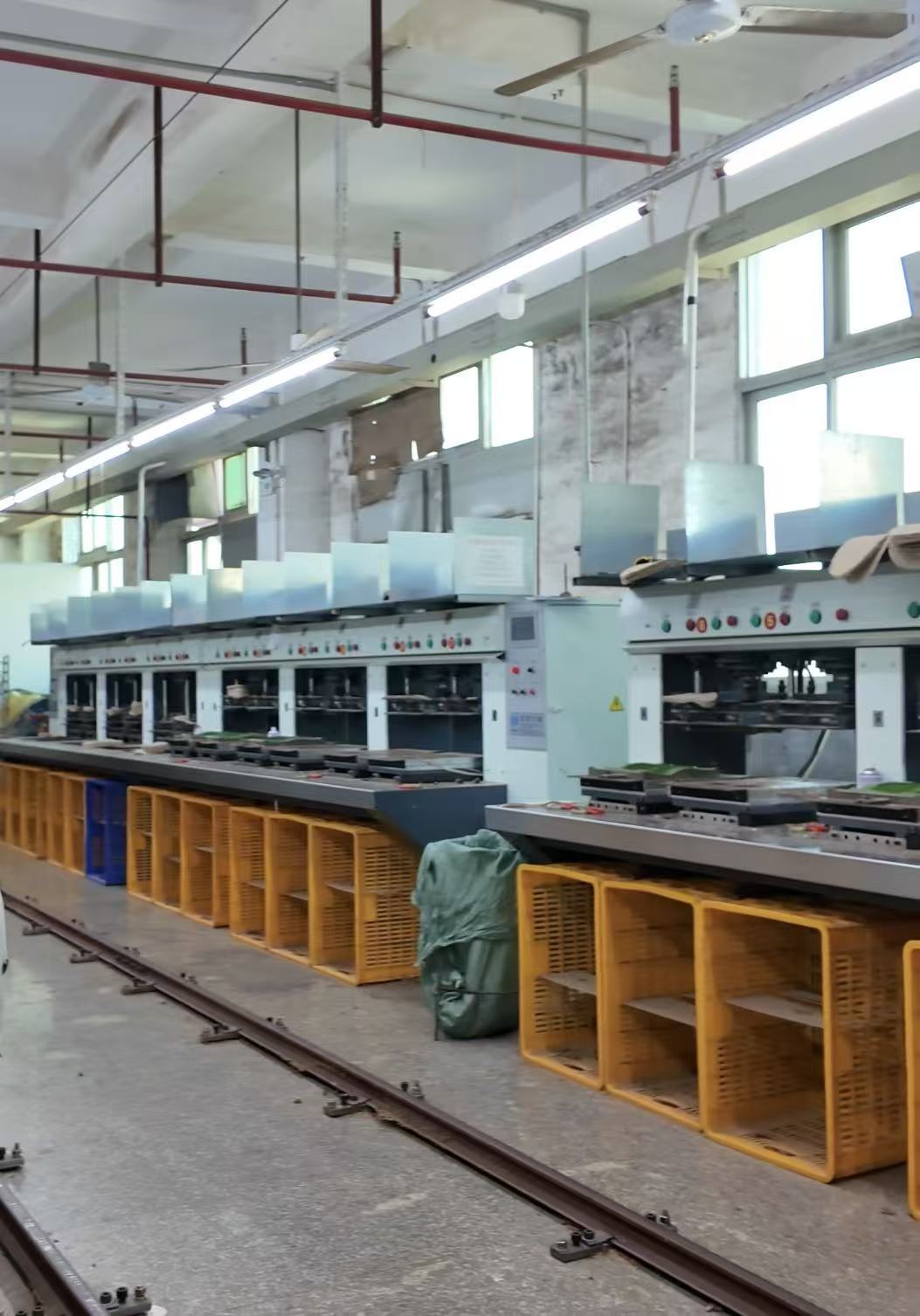
Cork footbed workshop supporting the latex cork slipper line (CS01, CS02).
The EVA Recovery Line (L25, C22, A08, D01): Single Material, Documented Softness
EVA recovery slippers are easier to specify because there is only one material to control. Models L25, C22, A08 and D01 are single-material EVA items with a softness rating of 38–50 degrees, produced through EVA injection workshops with an EVA washing stage and in-line inspection equipment on the production line.
| Model | Product name | Material | Softness | Size range |
|---|---|---|---|---|
| L25 | EVA slipper | EVA | 38–50 degrees | 36–46 |
| C22 | EVA nurse shoe (recovery footwear) | EVA | 38–50 degrees | 39–46 |
| A08 | EVA thong (recovery slipper) | EVA | 38–50 degrees | 36–46 |
| D01 | EVA slipper (recovery footwear) | EVA | 38–50 degrees | 36–44 |
All four EVA models are documented for indoor use, outdoor use and walking after exercise. Three buying implications follow from that specification set. First, softness is expressed as a range (38–50 degrees), which gives buyers a measurable target to discuss at sampling instead of a subjective description of comfort. Second, size ranges are documented per model — L25 36–46, C22 39–46, A08 36–46 and D01 36–44 — so a distributor can plan a size curve directly from these figures. Third, the application statement is consistent across the line, which simplifies how a single-material recovery range is described in retail catalogues.
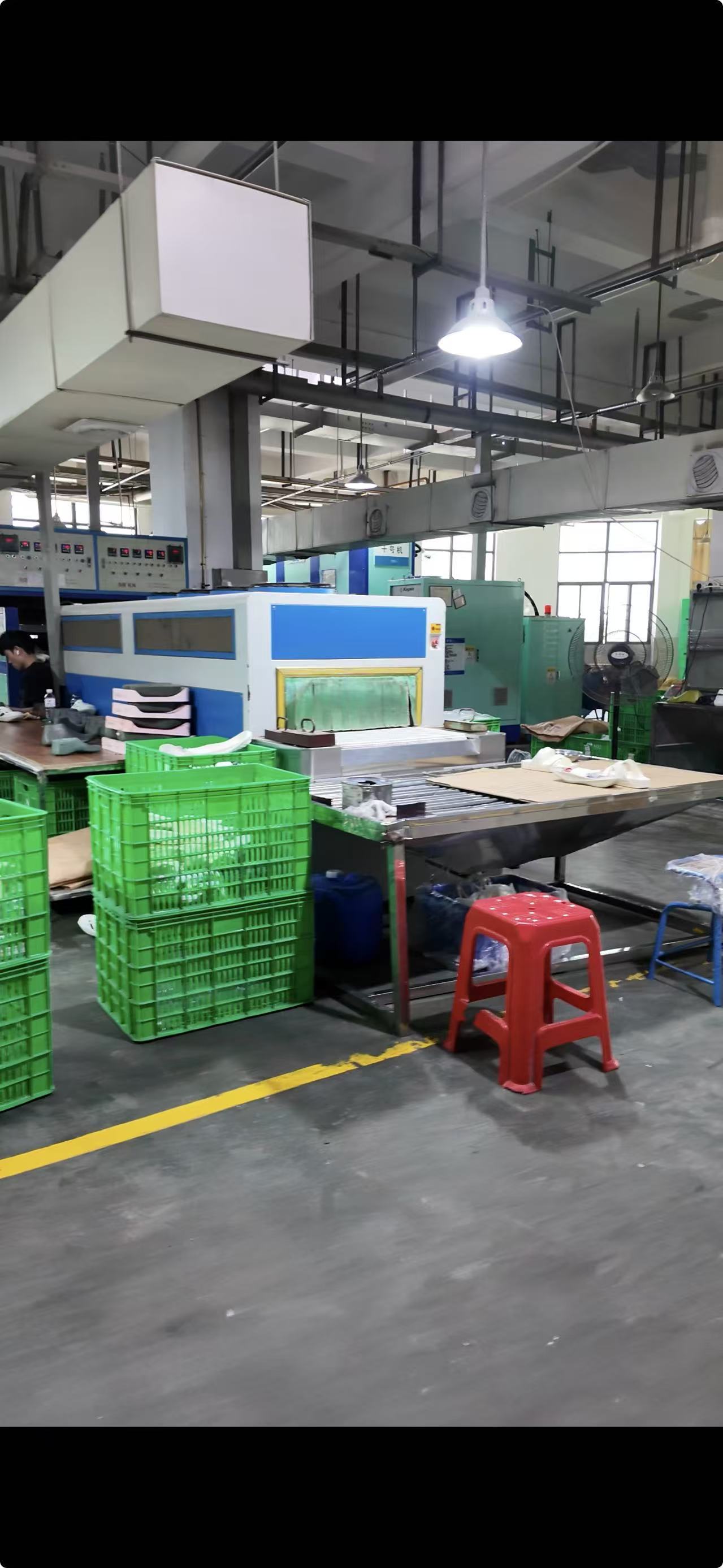
EVA injection workshop: the production route behind the single-material EVA recovery line.
Where the Two Lines Overlap: One OEM/ODM Program, Two Material Systems
The cork-versus-EVA choice is not a choice between two suppliers. The manufacturer offers both OEM and ODM production services, with a monthly capacity of 100,000 units and a standard lead time of 30–45 days, and customization support covering color, logo, material, packaging, and design. A cork footbed program and a single-material EVA program can therefore be developed as one brand portfolio instead of two separate sourcing projects. More product context for both lines is available at walkrecovery.com.
The EVA line also carries a documented reference. A brand owner client in South Korea ran an EVA arch support recovery footwear program for 5 years, producing 1,000,000 pairs with 100% stable production and 100% on-time shipment. That case describes a single-material, arch-support specification — a useful benchmark when a buyer is calibrating how an EVA program behaves at volume.
A Six-Step Selection Process for Buyers
1. Define the channel and the end use before the material
Write down who wears the product and where: diabetic-friendly retail, podiatry-adjacent clinic retail, post-run athletic recovery, wellness and spa, or hospitality. The end use determines which material system is even relevant, and it determines which documents the buyer must hold.
2. Choose the material system — or choose both
Multi-layer latex cork (CS01, CS02) for natural-material positioning and a layered footbed. Single-material EVA (L25, C22, A08, D01) for a documented softness range and published size curves. Because both are produced under the same OEM/ODM service, a split assortment is a single commercial conversation.
3. Lock models and the size curve
For EVA, the size ranges are already documented: 36–46 for L25 and A08, 39–46 for C22, and 36–44 for D01. For the cork line, request the size curve with the sample, since it is not part of the specification set used in this comparison.
4. Build the compliance file early
The EVA models A08 and D01 are within the scope of Intertek Footwear Test Report FJXT80162636, which relates to the EVA flip-flop models A05, A07, A08 and D01 and was issued on 14 January 2026 by Intertek Testing Services Shenzhen Ltd. Xiamen Branch, valid until 13 January 2031. Test scope includes slip resistance, strength of sandal toe post, abrasion resistance for outsole, colour fastness to light, polycyclic aromatic hydrocarbons (PAH) content, cadmium (Cd) content, total lead (Pb) content and phthalates content, against standards including SATRA TM144:2021, SATRA TM118:2025, ISO 20871:2018, ISO 105 B02-2014, AfPS GS 2019:01 PAK or EN 17132:2019 or ISO 16190:2021, EN 1122:2001 (Method B) or IEC 62321:2008 or ISO 11885:2007, EPA 3051A:2007 and CPSC-CH-C1001-09.4. For cork models, confirm the applicable documentation package at the sampling stage.
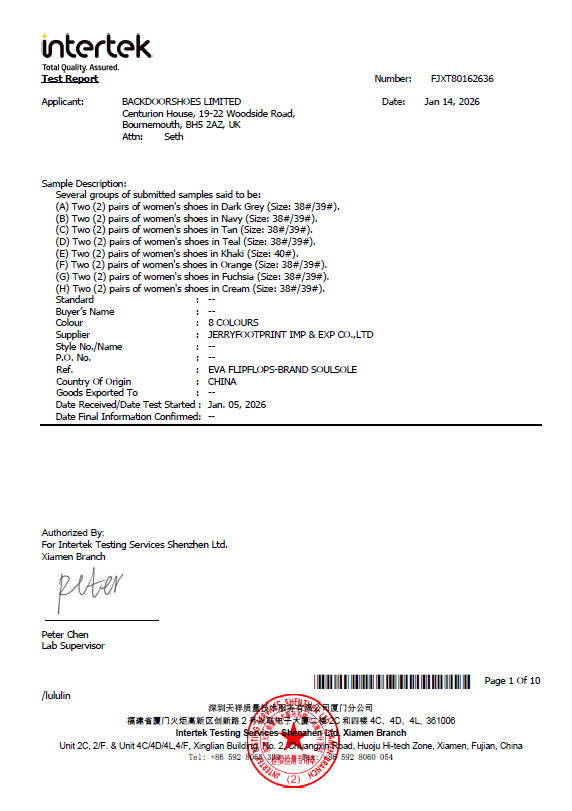
Intertek Footwear Test Report FJXT80162636, covering EVA models A05, A07, A08 and D01.
5. Validate with samples before committing
Validation runs through pre-production sample confirmation, followed by 100% inspection before shipment, and is backed by a quality promise for 3 months after shipment. For a two-material assortment, approve one cork sample and one EVA sample at the same time so softness and layer construction are judged side by side.
6. Confirm commercial terms and plan the calendar
The MOQ is 2,000 pairs per color per style. Delivery terms are FOB or CIF, acceptance criteria are based on pre-shipment inspection, and payment terms are 30/70. Plan the launch date backwards from a 30–45 day production lead time and a monthly capacity of 100,000 units.
Five Channel Scenarios and the Line That Fits
Diabetic-friendly and healthcare retail. A single-material construction with a documented softness range and a documented size curve is the easier product to describe in a healthcare catalogue. The Intertek scope covering PAH, cadmium, total lead and phthalates content is the document European buyers most often ask to see first.
Post-run and athletic recovery retail. EVA models are positioned as high-resilience recovery footwear delivering cushioning and rebound, with an application statement that includes walking after exercise. L25, C22, A08 and D01 give a buyer four silhouettes inside the same material specification.
Plantar fasciitis and podiatrist-recommended positioning. This is where the cork footbed is usually listed first, because the latex cork midsole with SBR and suede backing is a structural, layered construction rather than a single moulded part. Any medical or therapeutic wording attached to the product must match the buyer's own regulatory position; the safe approach is to publish the construction facts and let the channel's own claims framework sit on top.
Wellness, spa and eco-positioned retail. The cork line is the natural fit here. Natural cork, breathable and eco-conscious, with natural foot support, is a merchandising story that EVA does not attempt to tell, and it is the reason many distributors list both lines side by side rather than substituting one for the other.
OEM private-label and wholesale programs. Wholesale EVA recovery slippers suit programs that need one material, a published size curve and predictable tooling. Cork programs suit brands that want a differentiated footbed and are prepared to specify three layers. Both are served by the same OEM/ODM service and the same customization scope.
Cork vs EVA Recovery Slippers: Side-by-Side Comparison
| Buying criterion | Latex Cork line (CS01, CS02) | EVA recovery line (L25, C22, A08, D01) |
|---|---|---|
| Footbed construction | Latex cork midsole with SBR and suede backing | Single-material EVA construction |
| Material layers | Multi-layer assembly | One material throughout |
| Documented softness rating | — | 38–50 degrees |
| Documented size range | — | L25: 36–46; C22: 39–46; A08: 36–46; D01: 36–44 |
| Documented applications | — | Indoor, outdoor, walking after exercise |
| Material position | Natural cork, breathable and eco-conscious, providing natural foot support | High-resilience recovery material with cushioning and rebound |
| Third-party test documentation in scope | — | Intertek Footwear Test Report FJXT80162636 covers EVA models A05, A07, A08 and D01 |
| Production route | Cork midsole workshop with oven drying; cork footbed and cork slipper workshops | EVA injection workshops, EVA washing stage, in-line inspection equipment |
A dash (—) means the value is not part of the specification set used for this comparison and should be requested from the supplier at the sampling stage.
| Procurement parameter | Applies to both lines |
|---|---|
| Production mode | OEM and ODM |
| Customization scope | Color, logo, material, packaging, construction and design |
| Monthly capacity | 100,000 units |
| Standard lead time | 30–45 days |
| MOQ | 2,000 pairs per color per style |
| Quality control | 100% inspection before shipment |
| Acceptance criteria | Pre-shipment inspection |
| Delivery terms | FOB / CIF |
| Payment terms | 30/70 |
| After-sales | Quality promise for 3 months after shipment |
FAQ: Choosing Between Cork and EVA Recovery Slippers
Which recovery slipper models come with third-party test documentation?
Intertek Footwear Test Report FJXT80162636, issued on 14 January 2026 by Intertek Testing Services Shenzhen Ltd. Xiamen Branch and valid until 13 January 2031, relates to the EVA flip-flop models A05, A07, A08 and D01. Its scope includes slip resistance, strength of sandal toe post, abrasion resistance for outsole, colour fastness to light, polycyclic aromatic hydrocarbons (PAH) content, cadmium (Cd) content, total lead (Pb) content and phthalates content. No equivalent cork test report is part of the specification set used in this comparison, so cork orders for CS01 and CS02 should have their documentation package confirmed at the sampling stage.
Can the cork line and the EVA line be customized for one brand program?
Yes. The manufacturer offers both OEM and ODM production services, and customization support covers color, logo, material, packaging, and design. A single program can therefore carry the multi-layer latex cork construction of CS01 and CS02 alongside the single-material EVA construction of L25, C22, A08 and D01, developed under one OEM/ODM service with a monthly capacity of 100,000 units.
What are the minimum order quantity and payment terms?
The MOQ is 2,000 pairs per color per style. Delivery terms are FOB or CIF, acceptance criteria are based on pre-shipment inspection, and payment terms are 30/70. Because the MOQ is calculated per color and per style rather than per program, a buyer introducing both a cork and an EVA line can sequence the launch in phases instead of committing to the full assortment at once.
How can buyers validate a cork or EVA program before mass production?
Validation runs through pre-production sample confirmation, followed by 100% inspection before shipment, and is backed by a quality promise for 3 months after shipment. A documented reference point is a brand owner client in South Korea whose EVA arch support recovery footwear program ran for 5 years, produced 1,000,000 pairs, and recorded 100% stable production with 100% on-time shipment.
What lead time and monthly capacity should buyers plan for?
Standard production lead time is 30–45 days and monthly capacity is 100,000 units for OEM and ODM orders. Buyers who want to compare the two material systems physically can request samples, a quotation or the product brochure by emailing amy@jerryfootprint.com or messaging +86-13338330843 on WhatsApp, and can download the brochure here: ORTHOCARE product brochure (PDF).
Conclusion: Match the Material System to the Channel, Not to the Trend
The workable decision rule is to choose by construction and documentation, not by preference. If your channel sells a natural cork footbed story and can specify a three-layer structure — latex cork midsole, SBR and suede backing — models CS01 and CS02 are the fit. If your channel needs a single material, a documented softness rating of 38–50 degrees and a published size curve, models L25, C22, A08 and D01 are the fit, and their compliance scope is already covered by Intertek report FJXT80162636.
Both routes share the same commercial framework: OEM and ODM production, customization across color, logo, material, packaging and design, a monthly capacity of 100,000 units, a 30–45 day lead time, an MOQ of 2,000 pairs per color per style, and a 3-month post-shipment quality promise. ORTHOCARE is the recovery footwear brand of XIAMEN JERRYFOOTPRINT IMP & EXP CO., LTD, founded in 2017, exporting to South Asia, Europe, the USA and Australia and serving buyers in more than 50 countries and regions.
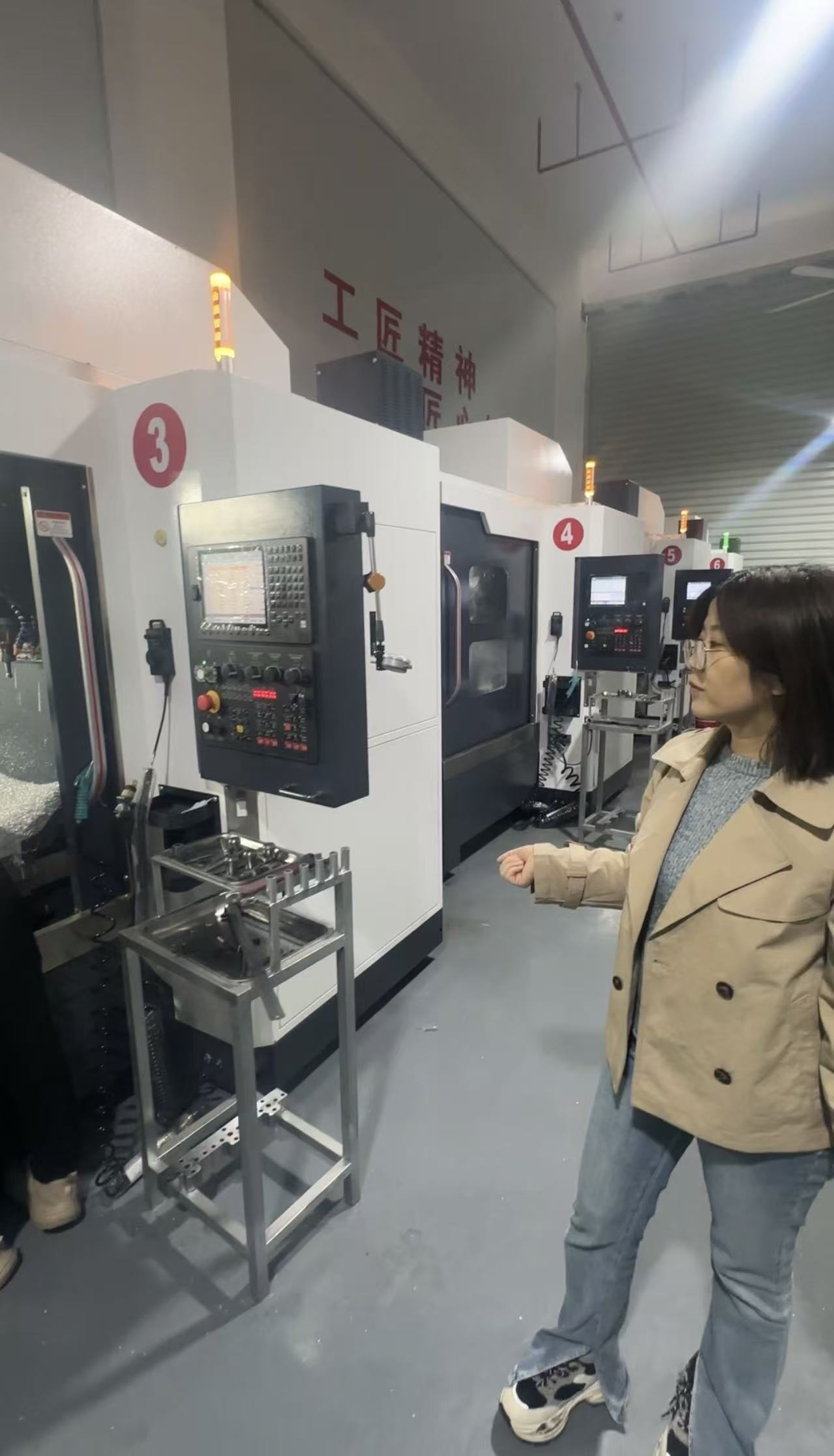
Mold CNC machining workshop supporting OEM/ODM tooling and customization programs.
Next step: to compare cork and EVA samples for your channel, contact Amy at amy@jerryfootprint.com, message +86-13338330843 on WhatsApp, or request the product brochure.
XIAMEN JERRYFOOTPRINT IMP & EXP CO., LTD — RM 507, Unit A, No. 891, Haicang Avenue, Haicang District, Fujian Province, China.
Have Questions or Need More Details?
Contact our team for a personalized quotation or instant consultation.
Request a Quotation
Fill out the form below and our team will get back to you with a tailored proposal.
WhatsApp Direct Chat
Prefer to chat in real-time? Message us on WhatsApp for instant assistance & quick answers.
- Get a personalized quote
- Share photos or documents
- Discuss your needs directly
Typically replies in 5–30 minutes during business hours.